
Venture philanthropy is becoming an important approach for donors who want their charitable capital to support meaningful innovation instead of funding administrative overhead. Many donors want more transparency, more involvement, and more measurable outcomes. Venture philanthropy offers a structured way to allocate charitable funds to early-stage companies working on serious problems such as cancer, climate change, mental health, and new scientific technologies.
This article explains what venture philanthropy is, how it works, why it is growing, and how donors can participate in a practical and strategic way. It also describes the difference between traditional charity and venture philanthropy, the challenges with conventional venture philanthropy funds, and how a modern model such as Next Round Philanthropy gives donors a customized, fee-free solution.
What Is Venture Philanthropy?
Venture philanthropy is a structured method of giving where donors use charitable dollars to support early-stage companies developing solutions to important problems. The goal is to create measurable impact without expecting financial returns. It combines the discipline of venture capital with the purpose of philanthropy.
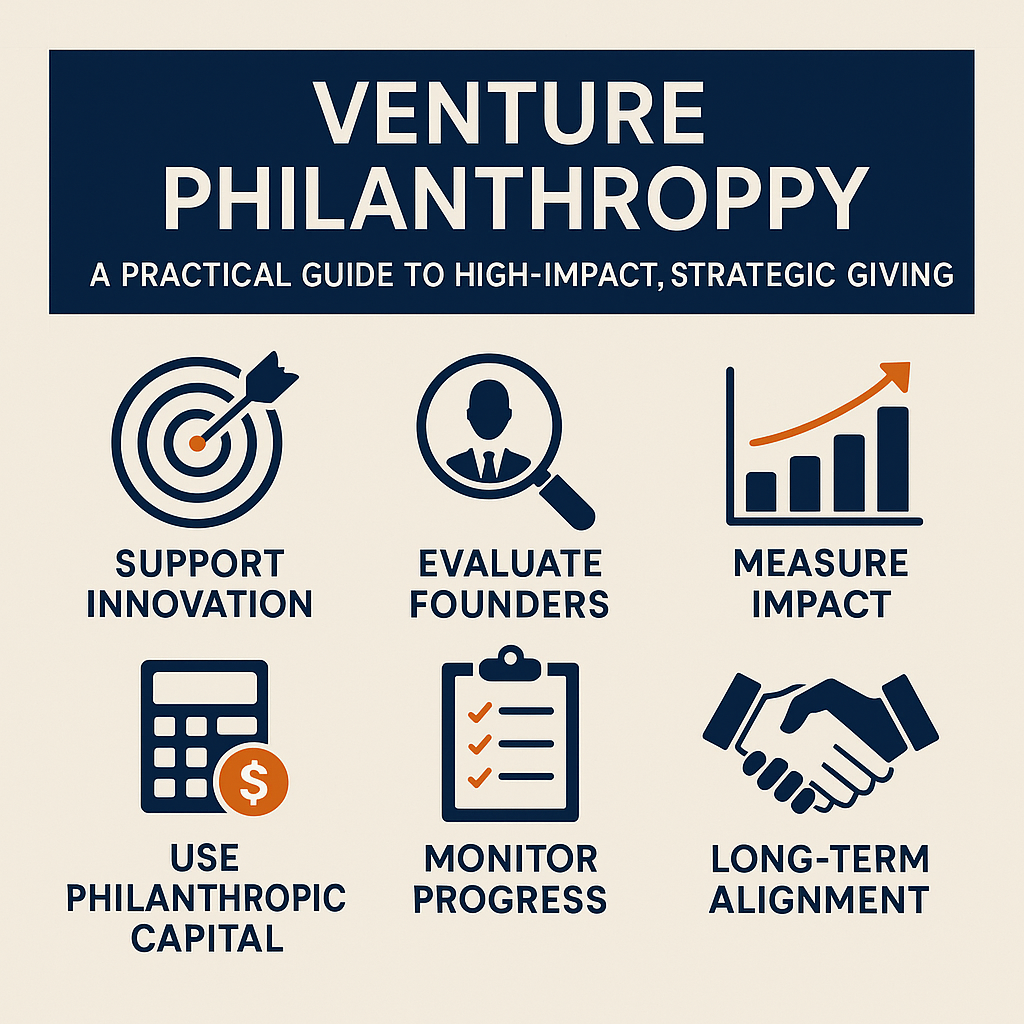
The core principles of venture philanthropy include supporting innovation, evaluating founders, understanding market viability, and monitoring progress. Donors maintain charitable deductibility when they use a donor-advised fund or a foundation.
The purpose of venture philanthropy is to allow donors to support mission-driven founders directly. Instead of sending money to traditional nonprofits, the donor helps build solutions that can scale and address systemic issues at the source.
Why Venture Philanthropy Is Growing
Venture philanthropy is increasing for several reasons. Donors want clear visibility into where their money goes. They want to avoid situations where a large portion of their donation funds overhead instead of solutions.
Early-stage companies working on lifesaving or world-changing technologies often lack access to early financing. Traditional venture capital tends to enter later in the process, once risk is lower. Venture philanthropy helps fill this gap.
Donors also want more involvement. They want to meet founders, understand their missions, and track progress. Venture philanthropy allows donors to be closer to the work being done.
Another reason for growth is alignment. Many donors feel strongly about specific causes such as new cancer treatments or clean energy. With venture philanthropy, they can direct their funds exactly where their values are.
How Venture Philanthropy Works
The basic process of venture philanthropy includes several clear steps.
A donor identifies the cause they want to support. This helps define the mission that will guide the rest of the process.
A team with experience in early-stage investing performs due diligence on potential companies. The evaluation includes the founding team, intellectual property, regulatory paths, business model, market needs, and competitive landscape.
A curated portfolio is assembled. The donor sees a list of companies aligned with their mission and chooses the companies to include.
Funding takes place through a donor-advised fund or a foundation. When using a donor-advised fund, the donor transfers capital into the fund, receives a tax receipt, and directs the fund to purchase securities in the selected companies. When using a foundation, the foundation wires funds directly to the companies.
The donor receives ongoing updates. This includes weekly or bi-weekly meetings, summaries, data room access, and direct communication with founders.
If a company has a liquidity event, the securities in the donor-advised fund or foundation convert to cash. The donor may reinvest in new innovators or grant out the funds.
This system creates a clear cycle of philanthropic investing that can repeat over time.
Venture Philanthropy vs. Traditional Charity
Traditional charity involves donating money to nonprofit organizations. These organizations often use part of the funds for administration, salaries, and fundraising. Donors usually have limited insight into how funds are allocated.
Venture philanthropy directs funds to companies working on solutions to the root causes of problems. It allows donors to observe progress more clearly through milestones, clinical trials, partnerships, prototypes, and scaling efforts.
Key differences include:
- More transparency
- Direct support of innovation
- Stronger alignment with donor passions
- Accessible reporting
- Higher engagement
- Focus on long-term solutions instead of temporary relief
Traditional charity remains important, but venture philanthropy provides an alternative for donors who want measurable impact and direct involvement.
Limitations of Traditional Venture Philanthropy Funds
Most venture philanthropy is structured as pooled funds. Donors contribute money into a fund managed by professionals who select the companies. These funds often charge fees similar to venture capital, usually 2% management and 20% of profits.
Common limitations include:
- High fees
- Limited donor involvement
- Lack of customization
- No choice in which companies receive support
- Minimal reporting
- Opaque fund management
- No relationship between donors and founders
Many donors want an approach that feels more direct, more transparent, and more aligned to their mission.
A NextRound Venture Philanthropy Model
Next Round Philanthropy (NRP) offers a customized approach that addresses many issues found in traditional models. Instead of using a pooled fund, NRP builds a bespoke portfolio for each donor based on their personal mission. This allows the donor to choose exactly which companies receive their philanthropic capital.
The model operates with zero management fees and zero profit share. Every dollar goes directly to founders. Donors maintain charitable deductibility when using a donor-advised fund or foundation.
Key features of the customized venture philanthropy model include:
- Personalized portfolios
- Zero fees
- Clear alignment with donor motivations
- Strong due diligence
- Weekly founder meetings
- Full transparency
- Access to data rooms
- Direct communication with founders
This approach gives donors a structured, intentional way to deploy philanthropic capital using a process similar to venture capital but with philanthropic benefits.
Why Early-Stage Innovation Needs Venture Philanthropy
Early-stage innovators face significant challenges in securing financing. Venture capital firms often prefer later stages where risk is lower. Philanthropic capital helps bridge this gap.
Industries that benefit from venture philanthropy include:
- Cancer research
- Autoimmune and neurological diseases
- Climate technologies
- Clean energy systems
- Space technologies
- Mental health solutions
- AI-driven scientific tools
- Biotech platforms
- Satellite imaging
These companies often work on urgent and important challenges that require support long before traditional investors are willing to commit capital.
How Donors Can Start With Venture Philanthropy
Donors who want to begin can follow a simple set of steps.
Identify your mission. Consider the issues you want to address and which outcomes matter most to you.
Review your charitable structure. Decide whether you will use a donor-advised fund or a foundation.
Select a venture philanthropy provider. Evaluate transparency, fee structure, due diligence process, reporting frequency, and alignment with your personal mission.
Engage with founders. Venture philanthropy offers direct communication, which helps donors understand the work being done.
Monitor progress. Weekly and bi-weekly updates allow donors to see tangible results.
Reinvest after liquidity events. When companies grow or exit, philanthropic capital becomes available for new rounds of support.
The Importance of Due Diligence in Venture Philanthropy
Due diligence ensures that philanthropic capital is directed responsibly. A strong due diligence process includes several components.
A review of the founding team is conducted to assess experience and ability to execute. Intellectual property is analyzed to understand defensibility. The market is studied to evaluate demand. Regulatory considerations are reviewed for biotech and health-related companies. Competitive landscape assessments help determine viability. Financial models are checked for realism. Technology readiness is evaluated to understand progress.
A structured due diligence process protects donors from supporting weak or unsustainable ventures.
How Venture Philanthropy Creates Measurable Impact
Venture philanthropy produces measurable outcomes because it funds projects that move through defined stages. These include research, development, prototyping, regulatory approval, clinical trials, pilot deployments, partnerships, and scaling.
Donors see real progress through milestones and updates. This structure gives donors confidence in how their philanthropic capital is used. It also allows for better long-term solutions compared to temporary relief strategies.
Venture Philanthropy FAQs
What is venture philanthropy?
Venture philanthropy is a method of giving that deploys charitable dollars to early-stage companies developing solutions to social, medical, scientific, or environmental problems.
Do donors receive financial returns?
No. Venture philanthropy is still philanthropy. Donors maintain charitable benefits, but returns go back into a DAF or foundation to support future giving.
How does venture philanthropy differ from impact investing?
Impact investing seeks financial returns. Venture philanthropy does not. It is entirely charitable in nature.
Can venture philanthropy be done through a donor-advised fund?
Yes. A donor-advised fund can purchase securities in selected companies at the donor’s instruction, while maintaining charitable deductibility.
What kinds of companies benefit from venture philanthropy?
Biotech, clean energy, mental health, neuroscience, climate technology, AI health tools, space technology, and other early-stage fields.
Why do donors prefer customized venture philanthropy?
They want transparency, reporting, control, alignment with personal values, and direct communication with founders.
How often do donors receive updates?
Updates may occur weekly or bi-weekly depending on donor preference.
What happens when a company has an exit?
Proceeds return to the donor-advised fund or foundation. The donor may reinvest or grant the funds to charities.